
Ari Wes, M.D., M.S., is a plastic surgeon and the founder of Wes Plastic Surgery, a facial aesthetics practice in San Francisco. He earned his M.D. and M.S. at the University of Pennsylvania and completed his plastic surgery residency and chief residency at the Hospital of the University of Pennsylvania. He has authored more than 50 peer-reviewed publications and focuses on facial aesthetic surgery, including facelift, rhinoplasty, and eyelid surgery.
Many men come to a facelift consultation assuming it’s the same operation women have, scaled to a larger face. It isn’t. A male facelift differs from a female facelift in the skin, the skeleton, the neck, the recovery, and the goal itself, which is definition rather than softness. Male facelift incisions are one of the clearest examples of how those differences change what I do in the operating room.
The first question most men ask me is where the scar will be. It’s a fair question, but it leaves out the detail that decides whether the result looks natural: where the beard ends up. In my office at Wes Plastic Surgery, a large part of the planning conversation with a male patient is about the beard, the sideburn, and the hair behind the ear, because a facelift moves all three.
Why the beard makes it a different operation
A facelift lifts the skin of the cheek and neck, moves it up and back toward the ear, and trims the excess along the incision. The skin that sits next to your ear afterward started out farther forward on your face. In a woman, that skin is usually hair-free. In a man, it’s often beard.
That one difference is why an incision pattern that works well in a woman can’t be carried over unchanged to a man. The beard border moves even when the scar heals perfectly, and a thin, well-placed scar doesn’t help much if there’s now beard growing on the tragus or right up against the ear. For a man who shaves every day, it’s also a practical problem, because the tragus is a small, curved piece of cartilage and an awkward place to shave.
Pre-tragal versus retro-tragal incisions in men
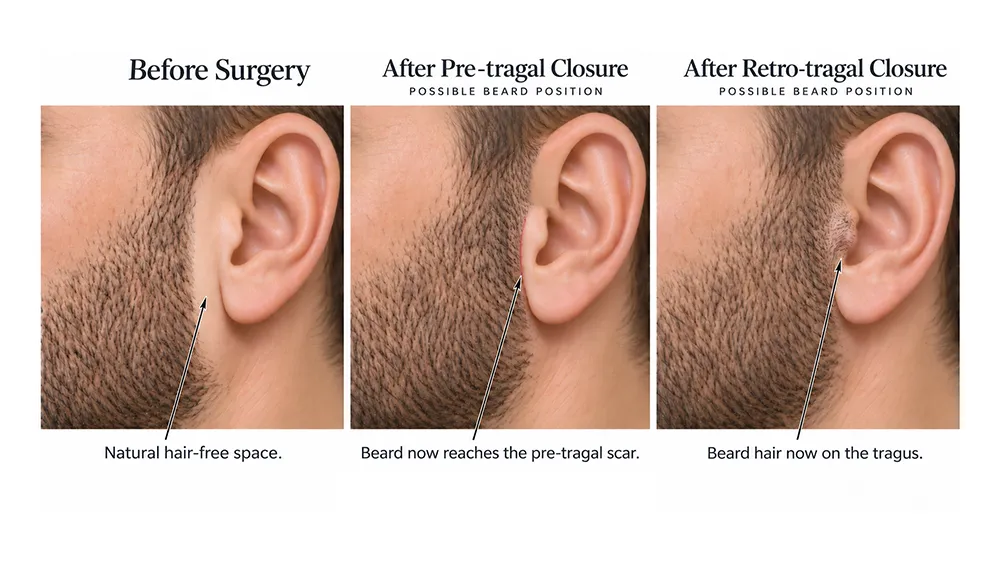
The tragus is the small cartilage prominence in front of the ear canal. A retro-tragal incision (sometimes called post-tragal) runs along its back edge, at the opening of the ear canal. A pre-tragal incision runs in the natural crease in front of it.
In women, I often use a retro-tragal incision, because the scar sits in the shadow of the ear and is very hard to see. In men, the same incision comes with a cost. The skin pulled back over the tragus to reach that incision is beard-bearing skin, and it keeps growing beard after it’s moved. That’s how men end up with hair on the tragus.
A pre-tragal incision stops the beard-bearing skin at the crease in front of the tragus, so the tragus itself stays smooth. The tradeoff is a scar in front of the ear rather than one tucked behind the edge of the tragus, and for most of my male patients I favor the pre-tragal incision for this reason. How well that scar hides depends on how defined the crease is, how thick the skin is, and how close the beard comes to the ear to begin with.
What a pre-tragal incision doesn’t preserve
This is the point I think is most often understated, and the one I most want men to hear before surgery. A pre-tragal incision keeps the beard off the tragus. It doesn’t necessarily keep the hair-free space in front of the ear.
Most men have a narrow strip of smooth skin between the back edge of the beard and the ear. Few think about it until it’s gone. When the cheek skin is advanced toward the ear and the excess is trimmed, the skin removed at the incision line often includes that strip. What’s left next to the scar is skin that used to sit farther forward, and in a man, that skin grows beard.
The result can be a beard that runs right up to the incision line. The tragus is still smooth, but the beard is closer to it than it was before surgery. How much closer depends mostly on how much skin is moved: a man with significant laxity in the lower face and neck needs more skin advanced, and loses more of that strip, than a man who needs a more modest correction.
Some men don’t mind. Others notice right away, because the clean space in front of the ear is part of how they’ve looked their whole adult life. If you’re in the second group, tell me before surgery. It changes the plan.
Treating hair follicles from beneath the skin
Even with a pre-tragal incision, some men want laser hair removal afterward to recreate that hair-free space. In my male facelift cases, I also address it during surgery: along the skin edge where I want less hair growth, I treat the underside of the skin. It’s a step with no equivalent in a female facelift, because there’s no beard to manage.
That’s possible because of where beard follicles sit. The root of each beard hair lies in the deepest layer of the skin and the fat just beneath it. Once the skin has been lifted during a facelift, that layer is facing me, so I can treat the follicles along the edge directly from below instead of working through the surface.
In some patients, this avoids the need for laser hair removal afterward. It reduces hair growth, though, and doesn’t guarantee a permanently hair-free zone. Some men still choose laser later to refine the border.
Laser has a limitation of its own. It targets pigment in the hair, so it works poorly on gray or white hair, and many men considering a facelift have a beard that’s partly or fully gray. That’s one more reason to settle the hair question in the plan rather than assume laser will take care of it afterward.
Sideburns, the temple, and a hairline that may change
The sideburn moves too. If the incision runs up into the hair of the temple, lifting the cheek skin can raise the sideburn and shift the temple hairline backward, and on a man a raised or shortened sideburn is easy to notice. When the skin needs to move more than the sideburn can tolerate, placing the incision along the front edge of the sideburn keeps it in position, at the cost of a scar at the hairline that has to heal well.
Behind the ear, the incision can follow the crease and then turn into the hair, or it can run along the hairline. Turning into the hair hides the scar better in someone with longer hair, but it can leave a step in the hairline at the back of the neck. Many men keep their hair short there, so I plan this part around how you actually cut your hair.
Future hair loss is a bigger factor in men than in women. A scar that’s covered by hair at 55 may not be covered at 65 if the temples recede or the hair thins. If you have a family history of thinning, or your temples are already receding, I’d rather place the incision for the hair you’re likely to have than for the hair you have today.
Bring photographs of how you usually wear your hair and beard, and tell me whether you shave daily, keep stubble, or wear a full beard. Each one changes which tradeoffs you’ll find acceptable.
A deep plane facelift doesn’t decide the incision
Patients sometimes assume that choosing a deep plane facelift settles these questions. It doesn’t. Deep plane describes what happens beneath the skin, where the SMAS-platysma layer is released and repositioned as a unit, and in a man I adjust that work too, favoring a direction of lift that sharpens the jawline rather than adding fullness to the midface. Where the incisions run and how the beard-bearing skin is handled are separate decisions, and the name of the technique tells you nothing about either.
Risks and limitations specific to male facelift incisions
Expect some change in the beard border. The skin moves, so the border moves with it, and the real questions are how much and where.
Men with short hair have less coverage for the scar behind the ear and at the back hairline. Hair loss can occur near the incisions, and while it’s often temporary, it can be permanent.
The general risks of facelift surgery still apply, including infection, nerve injury, and unfavorable scarring. Bleeding under the skin after a facelift is also more common in men than in women. No incision pattern removes every tradeoff, so the goal is to choose the ones that fit your face and how you wear it.
Questions worth asking at your consultation
Whoever you see, ask where the incision will run in front of your ear, how that differs from what they’d do for a woman, and whether beard-bearing skin could end up on your tragus or in the hair-free space beside it. Ask whether they plan to treat hair during surgery, how they’ll handle your sideburn and the hairline behind your ear, and whether you can see healed results in men with a similar beard.
If you’re considering a male facelift and want to know where the incisions would go on your face and what would happen to your beard, a consultation is the next step. The incisions are one part of building a facelift around a man’s face rather than adapting one designed for a woman’s, and that’s how I plan every male facelift at Wes Plastic Surgery in San Francisco.